
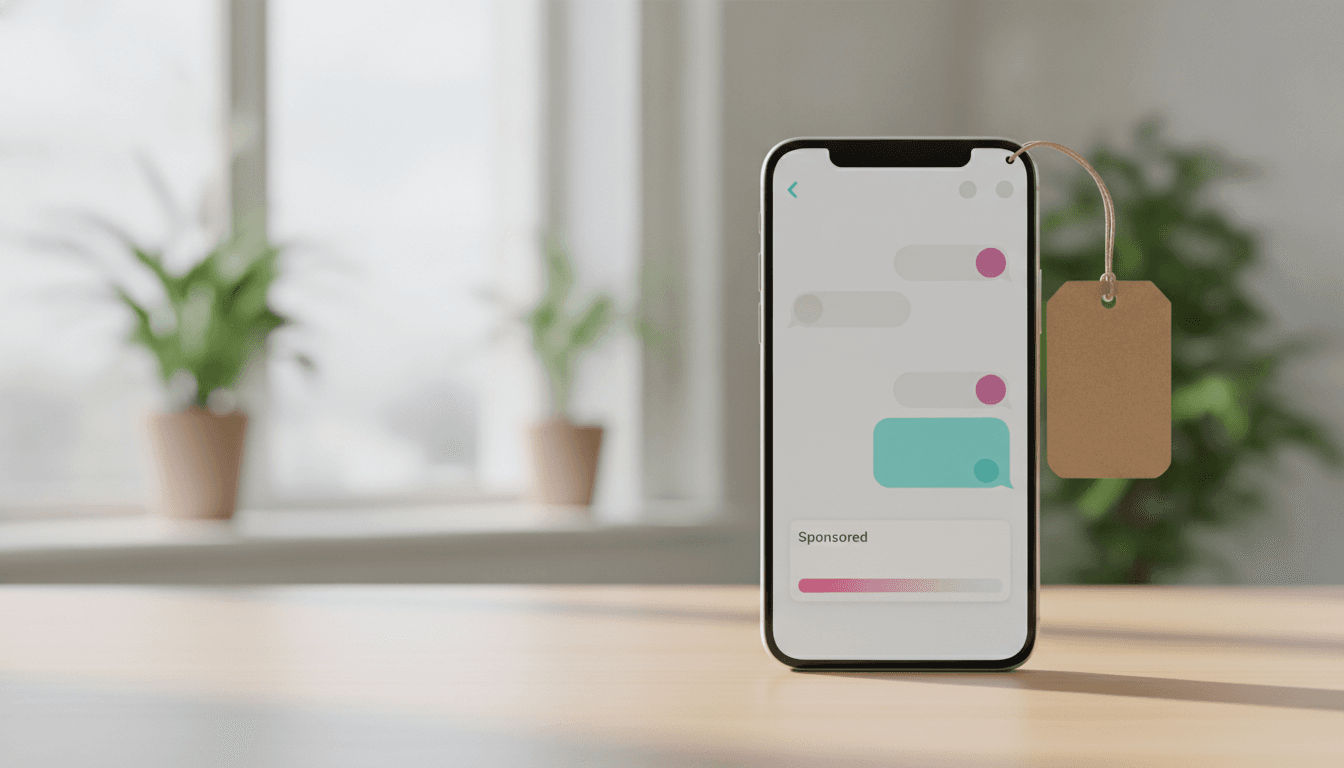
There is an old internet saying that makes sense again: if you are not paying for the product, you are the product. For years, using an AI assistant for free had a known cost: fewer messages and more modest models. In 2026 a new cost appeared, advertising. But the major AI companies did not all take the same path. Today at least six different strategies coexist, and understanding them helps decide which tools your team should be using.
OpenAI: the ad below the answer
ChatGPT was the first to turn its free plan into ad space. On February 9, 2026, OpenAI began testing ads for logged-in adult users in the United States on the Free and Go plans, leaving out Plus, Pro, Business, Enterprise and Education. The format is a "Sponsored" card that appears below the AI's answer and never inside it.
Targeting is contextual: the ad is chosen based on the topic of the current conversation, approximate location and device, without using chat history or memories unless the user turns on personalization. OpenAI also committed to not showing ads to users under 18 or next to sensitive topics such as health, mental health or politics.
The most interesting part is the trade-off it offers: Free users can switch to an ad-free mode in exchange for lower message limits. In other words, you pay with attention or with capacity.
In Brazil, ads have already arrived. The country was the eighth market in the pilot, covering the Free and Go plans (R$ 39.99 per month), and it is no small market: according to OpenAI, Brazil is among ChatGPT's three largest markets by weekly active users, with 50 million monthly users. The company backs the model with one figure: around 20% of queries carry direct commercial intent.
Google: advertising where search already was
Google did not need to invent anything: it brought its long-standing business to generated answers. In AI Overviews and AI Mode, eligible campaigns serve automatically and advertisers cannot opt out.
The Gemini app is a different story, at least for now. As of mid-2026, its free plan still had no ads. But the door is ajar: Nick Fox, Google's SVP, told WIRED that lessons from ads in AI Mode will likely carry over to the Gemini app down the road.
Microsoft: Copilot as an extension of Bing
Microsoft followed a logic similar to Google's in its consumer Copilot. Ads in Copilot are generated automatically from assets advertisers already have in Microsoft Advertising, and they appear inside responses across Copilot, Bing and Edge, with a format called Offer Highlights that surfaces promotions or free shipping directly in the chat.
Meta: no ads in the chat, but the chat feeds the ads
Meta chose the quietest path and, perhaps, the deepest. Since December 16, 2025, it has used conversations with Meta AI to personalize ads across Facebook, Instagram, WhatsApp and Messenger, with no way to opt out. The company says it excludes sensitive topics such as religion, sexual orientation, politics or health. The ad does not appear in the conversation; it shows up later, in the feed.
Perplexity: tried it and backed off
Perplexity pioneered sponsored follow-up questions in 2024, stopped accepting new advertisers in October 2025 and dropped advertising entirely in February 2026. The reasoning is telling: its leadership concluded that sponsored answers erode the trust a citation-based search engine depends on.
Anthropic: no ads as the product
At the other extreme, Anthropic made the absence of ads its central message. The company announced that Claude will remain ad-free and launched its first Super Bowl campaign with the tagline "Ads are coming to AI. But not to Claude." Its stated model is to earn revenue from enterprise contracts and paid subscriptions. One nuance is worth noting: the pledge includes a line saying that if they need to revisit this approach, they will be transparent about why, and the company is exploring "agentic commerce", where Claude could handle purchases or bookings on the user's behalf.
The public seems to value the stance: according to Ipsos, 63% of US adults say ads make them trust AI search results less.
What this means for companies
The pattern is clear: the free plan is paid for with attention, data or limits. For an organization, that has concrete consequences.
When an employee uses a free assistant account to draft a proposal or analyze a client, that conversation becomes the context that decides which ad to show, and in some cases it feeds ad profiles outside the tool. The enterprise licenses of these platforms are ad-free, but they only protect the people who actually use them.
That is why the question is no longer just which AI is most capable, but which AI is approved, under which license and with which usage rules. AI governance, a tool inventory and a clear usage policy become part of the same conversation.
Does your organization need to sort out which AI assistants your team uses and under which licenses? Let's talk at macareno.net.
Sources
- Ads in ChatGPT, OpenAI Help Center
- Free ChatGPT users get ads picked from whatever they just asked about, Help Net Security
- ChatGPT ads are rolling out, Proton
- ChatGPT começa a exibir anúncios para os planos Free e Go no Brasil, Correio Braziliense
- ChatGPT começa a exibir anúncios aos usuários do Brasil, Meio & Mensagem
- 2026 Guide to Advertising in AI Assistants, Lapis
- The AI Assistant Advertising Playbook, The Ad Spend
- Google Confirms It's Not Ruling Out Ads in Gemini, ALM Corp
- Meta Will Use AI Conversations to Personalize Ads, Dataslayer
- Anthropic takes aim at OpenAI's ad push in Super Bowl commercial, CNBC
- Super Bowl ad boosts Anthropic's Claude 11%, eMarketer